Wednesday, 19 June 2013

Could This Crazy-Sounding Weight-Loss Plan Actually Work?

Jorge Cruise, author of the number-one New York Times bestseller, The 100, claims that by limiting yourself to 100 sugar calories a day and eating whatever else you want — from bacon to hunks of cheese — you can shed pounds in a hurry. Skeptical, we asked the diet's mastermind for the 411.

How does the plan work?
The old way to look at a nutrition label is to see 0 grams of sugar. The new dietary science has shown that not all calories are the same. That means nutritional labels are written in a way that doesn't really matter. It's not about grams of sugar because carbohydrates are sugar — you need to consider the total amount of carbs. If you look at the average piece of whole-wheat bread, it will have at least 20 grams of carbs. You take number and quadruple it to find out the sugar calories. One slice of bread has 80 sugar calories, putting you almost at your daily limit. If you want to lose weight, whole-wheat bread, couscous, and quinoa are evil.

What happens to your body when you consumer sugar calories?
Eating carbohydrates — which are sugars — increases insulin. In our world, 80- to 90-percent of women's weight-gain comes from overindulging in insulin-stimulating food. And it's not hardcore, straight-up, I-can-see you-in-the-face sugar. They're eating whole-wheat bread. They're eating ancient grains. They're eating black beans. That stuff is horrible.

You claim that women can expect to drop 18 pounds in two weeks. Most nutritionists recommend on or two pounds per week. Is so much weight loss healthy or sustainable?
I think in America we've lowered our standards. If you have four pounds to lose, one or two pounds a week is great. But if you have 30 pounds to lose, and you're losing one pound a week, you're doing something wrong: you're eating carbs. You're eating whole-wheat bread and whole-wheat pasta. You're eating oatmeal with agave nectar and blueberries. It's all sugar.

When I designed this program, the average woman lost 15-to-20 pounds in two weeks. Is it healthy to lose that weight? The more important question is, is it healthy to keep that weight? No!

Since so much of the diet is about cutting carbs, it sounds a lot like Atkins. How is it different?
Dr. Atkins was brilliant, and he had a lot of good ideas. But, there was too much protein and not enough vegetables. You couldn't cook or bake with coconut or almond flour, which are vital parts of my plan. He recommended artificial sweeteners that we now know are dangerous. His plan was the iPhone 1. This is the iPhone 5.

What about Paleo?
You're supposed to be a caveman — it's disgusting! You're allowed to eat as much fruit as you want, and fruit is full of sugar. You eat one apple and get 99 sugar calories, which is enough for an entire day. That's fine if you're going to spend hours at the gym burning off those calories, but who has time for that?

Speaking of which, exercise is notoriously absent from The 100. Are you against it?
I'm not against working out. It's just not effective for weight loss. I like strength training to tone and firm the body so you look tight. But working out just makes you hungrier.

You present a list of "freebie" foods, which includes most meat, eggs, some vegetables, oils, cheese, and nuts. Can you really eat as much as you want of these things?
You have to be a mindful eater. There has to be intention in what you do in your life if you're going to be happy and authentic. Food isn't supposed to be entertainment in the way that your kids, your work, and your relationship are. Things that are fatty — like half-and-half or cheese — satiate hunger. A slice or two should make you full.  If you're eating beyond that, it's probably more about reacting to boredom or stress.

Okay, we're not sure we can get behind never eating comfort food again, but we think we get it. This plan isn't about getting to indulge in all your cravings and still lose weight, but it will get you fast results and offers KISS methodology that most anyone could follow.
Yes, people have it totally wrong about what's making you fat — that every single calorie has to be counted — but we now know that science has proven that wrong. All that matters is the sugar.

http://www.redbookmag.com/health-wellness/advice/the-100-diet

Monday, 17 June 2013

Q: How Often Should I Exercise?

A. According to Dr. Pietro Tonino, an orthopedic surgeon and sports medicine specialist at Loyola University Hospital, “celebrities look the way they do because they’ve followed their intense regimes for a long time. They also can afford ace trainers who make sure they don’t hurt themselves, vary their routines and keep them motivated”.
Another difference: “Most people that I know don’t have that amount of time to work out every day,” Tonino says.
Overexercising can be dangerous, warns the doctor. You might see some short-term benefit, but at the risk of long-term damage.
Among the hazards:
  • degenerative damage to tendons,
  • ruptured biceps or pectorals
  • and muscle strain.
mcconahay How Often Should I Exercise?
And all it takes is an hour a day…
“Thirty minutes a day to an hour a day would be a good workout,” Tonino says.
Which kinda makes sense.
  • Americans are told to perform moderate-intensity aerobic (endurance) physical activity for a minimum of 30 min on five days each week or vigorous-intensity aerobic physical activity for a minimum of 20 min on three days each week.
jackblack How Often Should I Exercise?
I’m too sexy for this shirt…
ooops, that’s only 60 minutes a week. And that only keeps you from dying, it doesn’t give you a six-pack.
  • In Canada, Big Brother recommends that all good little Canadians accumulate 60 minutes of physical activity every day to stay healthy or improve your health. Time needed depends on effort – as you progress to moderate activities, you can cut down to 30 minutes, 4 days a week.
Alright, 2 hours of moderate activity each week….making us twice as fit as the Yanks?
What about the Brits?
  • For general health benefit, adults should achieve a total of at least 30 minutes a day of at least moderate-intensity physical activity on five or more days of the week.  The recommended levels of activity can be achieved either by doing all the daily activity in one session, or through several shorter bouts of activity of 10 minutes or more. The activity can be lifestyle activity or structured exercise or sport, or a combination of these.
We have a Winner!!!
150 or more minutes of moderate intensity activity each and every week.
Okay, that’s it then, 150 minutes of moderate intensity exercise per week is your exercise prescription.
Wait a minute, what’s this?
In a new study, published July 28 in the Archives of Internal Medicine, researchers tracked 191 overweight and obese women to determine the exercise prescription required to maintain a weight loss of 10% or more of initial body weight over two years.

The Study

  • The women were instructed to eat between 1200 and 1500 calories a day.
  • They were assigned to one of four groups. The groups were based on exercise intensity (moderate v.s. vigorous) as well as the number of calories burned through exercise – 1000 to 2000 kcal per week.
  • The participants were encouraged to divide their exercise over five days a week and to exercise for at least ten minutes per session.
  • They also had regular contact with members of the Health and Physical Activity Dept at the U of Pittsburgh.

The Results

  • After six months, all of the women had lost weight.
  • About half of the group lost 10% or more of their starting weight.
  • However, after 2 years, only 47 (25%) of the overachievers were able to maintain their weight loss.
So how did the Fantastic Forty-Seven do it?
Researchers found that the women were averaging 275 minutes (1835 calories) of exercise per week. That’s 55 minutes a day on a 5 day schedule, or 40 minutes a day if you exercise every day.
As well, the women who exercised the most were also eating the least. On average, they ate 444 less calories than the women who exercised the least. It should also be noted that after crunching the numbers, the super group was eating 3108 less calories per week than the slacker group. And then when you add in the fact that they were also burning 1100 more calories per week, it’s no surprise that they did better than their chubby sisters.

Conclusion

Theirs: The addition of 275 mins/wk of physical activity,in combination with a reduction in energy intake, is important in allowing overweight women to sustain a weight loss of more than 10%. Interventions to facilitate this level of physical activity are needed.
Mine: Keeping in mind that I am a personal trainer and that I spend a good part of my day screaming for “one more rep”; I think that this research paints a realistic picture of the type and amount of activity needed to keep our society from getting fatter and fatter.
And before you say it, you do have 40-55 minutes of free time each day.
This also happens to be the demographic that carries the least amount of excess fat. Even worse, the fitness participation gap between rich and poor, black and white, old and young appears to be growing wider. So it seems that while more and more lily-white baby boomers are trying to get fit, the rest of the general population is getting fatter and lazier.
And before you say it, the rich actually have less free time than the rest of the great unwashed.
“People who make less than $20,000 a year, for example, told Kahneman and his colleagues that they spend more than a third of their time in passive leisure — watching television, for example. Those making more than $100,000 spent less than one-fifth of their time in this way — putting their legs up and relaxing”.
“Rich people spent much more time commuting and engaging in activities that were required as opposed to optional. The richest people spent nearly twice as much time as the poorest people in leisure activities that were active, structured and often stressful — shopping, child care and exercise”.
So, no more excuses, get your rear in gear.
Here’s your inspiration…
mattthe model How Often Should I Exercise?
Get off the couch!!!
Doug Robb is a personal trainer, a fitness blogger and author, a competitive athlete, and a student of nutrition and exercise science. Since 2008, Doug has expanded his impact by bringing his real-world experience online via his health & fitness blog, Health Habits.


Friday, 14 June 2013

How to be Skinny


We know that cutting calories has multiple health benefits and makes you thinner. But suppose we play tricks to be thinner without eating less – is there still a benefit for health and longevity?  This week we review Irvingia, Metformin, Pycnogenol, Green Coffee Extract, Acarbose, and old-fashioned amphetamines for weight loss. Also avoiding carbs and increasing fiber, intermittent fasting and bursts of exercise before eating.
Weight loss drugs have a bad name from the days when people were a little too eager to lose weight for appearance’s sake, and willing to take risks with their health to do so. Early weight loss drugs were stimulants, with all the associated risks: they make you feel good, they keep you from sleeping, they let you down, they’re habit-forming. Now we know that keeping weight down is an increasingly important part of staying healthy as we age. There is a new generation of drugs and supplements that work through different channels than the old ones, and some of them have long-term benefits independent of weight loss.
I’m coming from a perspective based on the loss of insulin sensitivity as a primary driver of aging. This is the essence of “metabolic syndrome” or “Type 2 Diabetes”, but in a milder form, this is a part of how we all age. Loss of insulin sensitivity causes us to gain fat cells, which exacerbates loss of insulin sensitivity in a vicious cycle. Metabolic syndrome, even in its mild form, is associated with increased risk of cancer and heart disease.  Simply eating less is the best medicine in principle, but a large majority of people who start off well by applying willpower end up actually gaining weight. [ref1ref2]   Hence there are tricks and treatments, strategies and diet fads. My advice (as usual) is to recognize that diet is very individual, to try different diets and diet aids until you find something that works for you. Here’s a brief guide to what’s available.
Green Coffee Extract
This is the latest among the new generation of supplements that affect the insulin metabolism. GCE slows the absorption of sugar and reduces the secretion of the enzyme (amylase) that turns starches to sugar in the digestive tract, and also blocks the enzyme glucose-6-phosphatase that makes sugar in the liver. Overall less of the food energy passing through the intestine is absorbed into the body, and to this extent taking green coffee extract should be expected to have the same benefit as eating less.
The primary active ingredient may be chlorogenic acid, but its effect has not been separated from other phytoesters included in the extract. The extract contains no caffeine*. In the best results to date, subjects lost an average 8 kg over 22 weeks, without consuming less calories.  A 2011 review (before this latest study) found clear evidence that GCE is effective as advertised, but bemoaned the fact that all the research in the field was linked to companies that stood to pofit from the sale of GCE.
Chlorogenic acid is also found in sunflower seeds and prunes.
Irvingia
Leptin is a hormone that signals your brain that you’ve had enough to eat, and signals your fat cells to burn up their fat stores. As we age, we lose sensitivity to leptin (as to insulin). Irvingia is the extract of an African bush mango, purported toincrease leptin sensitivity.
There are reports of large weight loss in a short time with irvingia, [ref1ref2] ,  but the studies are short-term and there are ambiguities in their design, so results are often summarized by reviewers as “inconclusive”.  [ref1ref2]
Other ways to prepare the insulin system before eating
There are several other foods reported to help prevent the insulin spike from a meal, when taken 20 before eating anything else. These include cinnamonvinegar, andgrapefruit.
Pycnogenol
Lowers blood sugar after eating, effectively improving insulin sensitivity. This is a supplement in the same class as others mentioned here, and may offer long-term health benefits including longevity, but no effect on weight reported.
Metformin
Previously reported on this page, metformin is a prescription drug that has been the treatment of choice for diabetes for over 40 years.  It lowers cancer risk so effectively that we speculate it might be useful for non-diabetics as well. Weight loss from metformin is primarily by appetite suppression. Blood sugar is lowered by metformin, and yet people feel more satisfied and eat less. The reported weight loss in studies of metformin is modest compared to irvingia, but it tends to stay off (irvingia studies are all short-term) and the studies are well-controlled. [ref]
Acarbose
This is a prescription drug that slows sugar absorption from the stomach, mimicking a low-carb diet without restriction of carbs. It is effective in avoiding diabetes, and shifts the body toward a “younger metabolism”. But no weight loss has been associated with acarbose, perhaps because the slow sugar absorption leads to slow signaling of satiety.
Other tricks to lose weight
Exercise is #1. A few minutes of exercise just before eating signals the body that “this food is to be burned, not stored”.  Intermittent fasting has been mentioned in this column, and works for some people. Filling the belly with high-fiber food is a favorite trick of mine. I eat mountains of green leafies, and half a cup of raw wheat bran every day. It’s my impression that wheat bran has “negative calories” in the sense that food goes through me faster and less of it is absorbed when I eat large quantities of bran. (I have seen no studies on this, and have only my personal experience to report.) I suspect that nutrients are adsorbed on the bran and excreted with the stool, so I try to take my supplements in a different meal from the bran. I’ve adjusted to bran and it doesn’t give me the runs, but, not to put too fine a point upon it, let’s just say that I don’t worry about constipation.
ConclusionThe most promising of the new generations of supplements that affect absorption of calories are green coffee extract and irvingia. Weight loss from the two seem to be large and of similar magnitude. And the evidence for both suffers from suspicion that the researchers had financial ties to the companies that sell these products. (Someday, I want to live in a country where taxes pay for independent medical research, so that we all have unbiased information about foods and drugs that is not linked to their sponsors.) In addition to aiding with weight loss, both are likely to have positive long-term benefits for health and longevity.
Metformin has the disadvantage of being available only by prescription, but it is better-studied than either of the two supplements, it has been around for 50 years, and is known to be safe and effective. It works by a slightly different mechanism, but is also likely to produce supplementary benefits for long-term health.
There is a huge amount of individual variability in all these studies. It makes sense to experiment on yourself to learn what works for you. You can’t judge by your weight loss from one day to the next, because that is dominated by water retention and salt intake. But if you weigh yourself daily in the morning and stick with a trial for at least two weeks, you will be able to tell what is working and find a program that’s effective, and that you can live with.
* Caffeine may have benefits and costs for insulin sensitivity as well as costs for cardiovascular health. Many epidemiological studies have identified a net effect of lower mortality rates in people who drink modest amounts of coffee.
###
This article orginally appeared on Josh’s blog here: http://joshmitteldorf.scienceblog.com/2013/06/09/how-to-be-skinny/

Sunday, 9 June 2013

5 Ways to Stop Dieting and Start Losing

Half of all dieters quit within a month! Maybe it’s time to stop dieting and start losing?

So, why do so many dieters throw in the towel so soon?  Most of those surveyed said that the program was too hard to follow and they couldn’t eat what they love.
There are oodles of reasons why popular diets rarely lead to long-term weight loss success. That’s why most dietitians, like us, recommend a non-diet approach to losing lbs.
We advocate changes to your eating and lifestyle that you can actually live with—not for just for a week or month or two—but for the rest of your life.
In the US, nearly half of us are on a diet and two-thirds of us are overweight or obese. Clearly, the diets most Americans are trying to peel off pounds don’t work. Fad diets, fasts, gimmicky products are a major part of the problem and we’re spending over 30 billion dollars a year on weight loss products and services that don’t work in the long run.
Instead of going on a strict diet that you can’t sustain,  take a more balanced approach and focus on the quality of the foods you’re eating like fruits and vegetables, lean proteins and whole grains. Calories do count so find ways that are the easiest to live with that help you cut out 250-500 calories from your normal diet. Upping your exercise always helps too. It will help burn additional calories and helps to keep your metabolism higher as you drop pounds.


1. Skimp on liquid calories. Because they provide essentially no satiety value whatsoever, those calories are essentially wasted. I also eat a higher protein diet and focus on the most filling foods (ones that provide the biggest volume or serving size for the calories) to help manage my hunger.
2. Limit alcohol. Alcohol stimulates your hunger, while decreasing any willpower or inhibitions you may have to say, a pint of Haagen-Dazs or a gooey brownie. That’s a double-punch that you probably don’t want to fight.
3. Avoid exercise fat traps. I’ve learned the hard way through 20+ years of being super athletic that I can’t eat whatever just because I work out a ton. It just doesn’t add up. The calories you eat far exceed what you can burn off with exercise. You’d be shocked to realize that you need to walk or jog for several miles to burn off just a few bites of a delicious dessert.
4. Don’t skip meals, especially breakfast. In fact, over the years, breakfast has become my second largest meal, after dinner, because of point number 5.
5. Don’t eat after dinner. I’ve followed this rule for about 5 years now and have never missed nighttime snacking. I normally eat dinner around 6:30 pm and go to bed around 9:30 pm. Nighttime noshers add hundreds of generally junk calories to their diet, making it hard to lose weight.
We find that most people don’t have to completely overhaul their diet to be successful in winning at losing: often, a few small changes to your daily food choices, lifestyle, and other habits, you can wind up losing weight once and for all.

Saturday, 8 June 2013

An Excuse to Eat

You should hear the kind of rationalization that goes on in my head sometimes. You may read my blog and think I have this weight loss and maintenance thing down! Most of the time I do. But I’m not perfect and I can be just as bad as the next guy who struggles with their weight. Trust me.
One example I can give comes from the time period where I was trying to lose weight. I was probably at 60-70 pounds lost so far and not far from reaching my goal weight. I don’t know what was really going on during this time period that triggered this but I went through a phase of midnight eating. I’m not proud of it. I’m glad I lived alone at the time so I didn’t have to justify to my partner why I was stuffing my face with rice krispie treats at 1 a.m. but maybe that would have been a deterrent. Anyway, I went through this phase and for some reasonTHOSE CALORIES DIDN’T COUNT. Don’t ask me how I rationalized that. For some reason, anything I ate between midnight and 2 a.m. didn’t count and I didn’t record it in my food journal. Totally bad. I was sabotaging myself (and this is probably one of the reasons I had such a long plateau around this weight).
Think about the last time you ate something and didn’t lot it in your food journal. Why didn’t it “count” for you?

Justified

What is the first thing that comes to your mind when I use the word justified?
justified100308_560
Sorry, I’m not talking about Raylon Givens when I used the word “justified.”  I’m talking about all those times we ate something that self-sabotaged our progress and justified our reason for doing so. I am not immune to this! I do it all the time. When I’m cooking dinner with Michael and I nibble and snack and bite on random things while we cook. I’m much better now at including those calories because you BET they count!
“I ran an extra mile today.”
“Work sucked today.”
“I’ve eaten so good all week long!” <–So why don’t we KEEP eating good?!?!
“Swimming in the pool actually burns MORE calories than I think it does because of the temperature!”
The list can go on and on and on as to why we make allowances for the extra snacking. The question to ask ourselves is this: why am I keeping myself from being successful? That damn handful of Reeses’s Pieces don’t taste nearly as good for the 20 seconds I’ll eat them, as reaching my goal will feel!

Entitled

I think this is the biggest trap we all fall into and I think a lot of it has to do with our culture and rituals as a family. How many times have you felt entitled to eat? What I mean by this is the Christmas cookies, the pumpkin pie and extra stuffing at Thanksgiving, the chocolate on Valentine’s Day…what about Superbowl? Or the 4th of July? There are excuses year round we can use to make ourselves feel entitled to overeating.
Check out this post: Emotional Eating: Do You Feel Entitled to Eat? Emotional eating opens up a whole bigger can of worms.
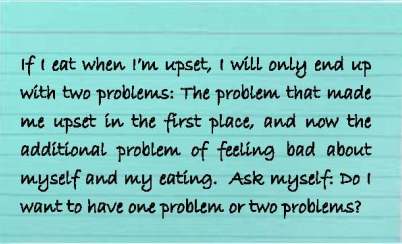
2012-06-18-DietresponsecardforHuffPost2
It’s a vicious cycle. I can’t tell you how many times I got sucked into this cycle when I was a binge eater. Eating half a pizza by myself followed with a carton of ice cream and then wondering why I feel sick and miserable…only to feel even more discouraged and disgusted with myself which leads to more comfort eating.
BREAK THE CYCLE! Instead of focusing on the foods I couldn’t eat or beating myself up for mistakes I made, I focused on my goal and my timeline and I changed my thinking to the positive: I CAN DO THIS. I can lose weight. I can resist the temptation of junk food. I KNOW I CAN. I said it over and over until I believed it and it got easier to resist the junk food.

I’ll Start on Monday

I have a friend that falls into this category. For as long as I’ve known her, she’s been starting a new diet on Monday. As a result of this, she often binges before the diet starts. This is a hard habit to get into because not only does it imply that we’ll be starting a super restrictive diet that we’re most likely going to fail at, we’re probably packing on extra pounds before we even start!
What worked for me to stop this mentality was to realize that I was not on a diet, I was changing my life and creating a new lifestyle. This wasn’t temporary and I wasn’t looking for a quick fix. I was changing EVERYTHING. That helped me stay “on the wagon” when I was tempted to fall off and just start over again. And you know what? Once I started losing a lot of weight, I realized that I had worked really really hard for that success and I didn’t want to mess up and fail! I wanted to keep moving forward.
Don’t wait til Monday. Start today. You’re worth it!

Change

Why not have the reason to eat be “I’m hungry”?
Simple, isn’t it? It’s a hard thing to retrain our minds to listen to what our bodies are telling us. What helped me was eating more whole, natural foods. Also, running and biking helped me look at food as FUEL. Once I changed my mindset to wanting to eat the RIGHT fuel for my body to succeed in athletics, it became super easy to recognize the right signals.
It’s not going to become easy overnight, and it will certainly be something you have to work at. But isn’t it worth it? I thought it was!

Friday, 7 June 2013

Losing Weight: It’s as Easy as 1-2-3

by John McGran
Special for eDiets
I’m going to let you in on the “magic formula” for weight loss — all you have to do is take in fewer calories than you burn.
It really is as simple as that. So, why do so many of us fail at it? Well, mainly because we fail to plan to succeed.
If you’re ready to do it right this time, incorporate these three plans of attack.

 1. Make a clean start

There’s nothing I hate more when dieting than opening the pantry to grab a can of tuna and coming face-to-face with a box of cupcakes. At times like this “Just say NO” is rarely an option.
If you’re following an AA lifestyle, you wouldn’t leave bottles of booze around your home… would you? When quitting cigarettes, you wouldn’t stash a pack of smokes in your glove compartment… would you?
So when quitting bad eating habits, it’s crucial that you not set yourself up for failure. Grab a box or bag and start cleaning house. It’s out with the old and in with the new for you.
It’s important that you replace the junk food with diet-friendly snacks and foods. Snacking healthily between meals can keep you focused and on track.
Stock up on fresh fruits and veggies. There are oodles of diet foods and drinks on the market. Try to stick with ones that aren’t overly processed or those that contain dozens of chemical additives.

2. Have a plan, StanLosing Weight is as Easy as 1 2 3

It’s nice to resolve to lose weight, but you can’t leave your weight loss resolution that ambiguous. What you should tell yourself is, “I WILL lose 10 pounds over the next four weeks”… or “I WILL lose 50 pounds by the end of the year.”
Now you need to plan how to hit a few milestones along the way. Do some research. Ask friends who’ve lost weight — and kept it off — how they accomplished it.
We all know someone who dropped a lot of weight on a fad diet. Sadly, they almost always gain back that weight in time. Steer clear of trendy fad diet plans.
Pick a plan that works for you and fits your food preferences. Keep track of calories and know how many you need to feel good and lose pounds.
Too few calories can send your body into starvation mode and make you stop losing pounds. Too many calories and you’ll never see progress.

3. Sweat the small stuff

Okay, once you settle on a sensible diet you really need to include exercise into your routine. Exercise alone doesn’t lead to weight loss BUT exercise combined with a good diet will turbocharge your metabolism and get your body burning more calories.
As you begin to slim down and firm up you’ll be more motivated than ever to stay the course.
Despite what you may think, we all can find the time for exercise. No need to give up your favorite TV shows either. Instead, get off the couch and on the floor for calisthenics or weight training during commercials.
You don’t need to join a gym or buy pricey equipment or spend hours sweating and grunting. A little activity goes a long way towards shaping up and feeling reenergized.
There you have it: the three basic steps for your diet to succeed. Armed with this information, you’re ready to start losing the weight that has cramped your lifestyle and endangered your health for far too long.

Thursday, 6 June 2013

The Fit 5: Fighting Fatigue

Our fitness expert drops knowledge on how to hit the gym fired up with energy, each and every session.

Photography by: Thinkstock
man holding a dumbbell

For all of our fans who shoot us questions on our Twitter andFacebook Page, this one is for you. Each week, we will tap into our pool of editors and experts to help with any questions or challenges you are having with your fitness regimen. This week,Tommy Caldwell, founder of Hybrid Health Corp. as well as host and creator of the Outlaws of Health radio show on iTunes answers questions about training, eating and planning to continuously perform your best, session after session.

Q1: How much rest is appropriate in between sets? Amount of weight?
"Rest taken between sets is dependent upon the goals you have set for yourself. A good rule of thumb is to keep your rest shorter (30-60 seconds) for weight loss, or high rep/light weight training. Keep rest moderate (60-90 seconds) for strength gains, or mid rep/moderate weight training. And implement long rest periods (2 minutes plus) for power gains, or low rep/heavy weight training.
Just remember that the less weight you’re lifting, the less rest your nervous system needs. The more weight you’re lifting, the more rest your nervous system needs."

Q2: What are the best kinds of foods to eat before a high intensity workout?
"There are two macronutrients that will significantly aid in the sustainability of high intensity training: Fats (medium chained) for a more sustained energy source and carbohydrates (higher glycemic) for an immediate energy source. Either or will help fuel your training session, but the combination of the two is optimal. For fats stick to eggs, nuts, and omegas in smaller quantities and for carbs stick to fruits, coconut water, or a natural fruit juice mixed with your water.
If you’re also looking to replace the key minerals that you’re going to lose throughout your training session (electrolytes), be sure to add a pinch of sea salt or a few tablespoons of apple cider vinegar to your water."
Q3: How many days should I be working out vs. taking off?
"This is dependent upon what you’re trying to accomplish. If you’re training lighter but with greater pace (muscular endurance, fat loss) you can train 5-6 days per week. If you’re training for strength with moderately heavy weights than 4-5 days is likely where you want to keep your work within. If you you’re lifting extremely heavy with big compound movements, you’ll likely want to keep your training frequency to 3-4 days.
Higher paced training with lighter resistance requires less rest in order to keep your brain in check. Heavy lifting, however, requires much more significant rest time. This may be counterintuitive since you’re likely to get less muscle soreness with heavy weights and minimal reps, but remember, your brain and nervous system require much more significant rest than your muscles do."
Q4: I've heard things about 'active recovery', what is that?
"Active recovery is essentially any physical activity that you can perform that isn’t closely related to your regular training stimulus. Let’s assume that weight training takes up the majority of your work load- basketball, squash, swimming and even running could be categorized as active rest in that case. As long as the activity is significant but completely unrelated to the movement and stimulus you’ve been putting yourself through repeatedly during the week, you can log it under the ‘active rest’ tab."
Q5: What are the most important aspects to giving 100% in my workouts?
"Get rid of the social aspect. Go to the gym to work, and don’t waste time doing anything else.
Understand what your real thresholds are. Some people believe they are working hard without ever truly testing their boundaries. Be safe, but push the envelope of your personal training barriers.
Have a plan, and stick to it. If you know what you’re setting out to accomplish before you even step into the gym (which you should), make sure that you don’t allow yourself any slack."

Tuesday, 4 June 2013

Willpower: The Key To Weight-Loss


Willpower: The Key To Weight-Loss

You can achieve anything you set your mind and focus on it. The key is to discipline yourself to continue despite the difficulties you will face. Most of us can easily perform a multitude of exercises to try and get our dream bodies. But unless we have willpower for weight loss, we will find it difficult to stay on the weight loss bandwagon for long.
It’s a ferocious cycle when a poor diet which is full of carbohydrates, fats and processed food makes our bodies lethargic and tired all the time. Then the body beings to lack the proper energy it requires making you less likely to exercise. This leads to a reduction of willpower and unhappiness.

But there is hope! Here we will outline a few simple measures you can take to boost your willpower for weight loss and set you on your way to that perfect summer body.

Watch That Portion!

Here is one tip all successful dieticians give to people who start new routines. Start small! It’s difficult to find the willpower to jump from one extreme point to another. So instead of completely changing what you eat, start your diet by reducing your portion size so that you end up consuming fewer calories. A great trick that you can apply is by using smaller sized plates. This makes the portion look larger.

You Can Cheat One Day!

It's easier to transition into a new diet if you allow yourself to have some fun once in a while. You can set yourself a cheat day where you can enjoy foods that are not on your diet plan. You are less likely to give up your new routine knowing the fact that you can eat some chocolate cake once in a while instead of never again! Remember a reward day does not mean an over-eat day!
Keep your portions limited; savor the flavor of the food. Even if it means having a smaller piece your willpower for weight loss should kick in and restrain you.

Photograph Yourself!

A great way to motivate yourself and keep your willpower for weight loss up is to take self portraits. We really don't have the best idea on how we look and our progress until we see our photographs. You can even keep a picture of yourself from when you started with you routine. You can look at it when you feel like giving up. This will boost your desire to keep at it and stick your diet.

List Things Down!

A great way to kick off a new diet is by planning it properly. Begin by listing down all the foods that you enjoy eating and evaluate whether these items are healthy or not. It is entirely possible that there a few very healthy foods that you enjoy eating such as vegetables and fruits. When you do find these items make sure you stock up so you can curb your cravings with healthy choices.

Exercise Light!

Adding exercises to your routine can be a difficult and daunting task. If try and add too many things too quickly your body will be exhausted and you can lose your willpower for weight loss. You shouldn't engage in rigorous workouts that you don't enjoy. The best way to get that exercise into your routine is by discovering things that you enjoy doing. Playing any sport such as tennis, squash or football can add all the exercise that your require. Swimming and cycling are also great alternatives for those people who do not enjoy the gym. Find what suits you and remember to start slowly!

Take Baby Steps!

It doesn't matter how you choose to approach your weight loss. But it’s important to remember that you should take small steps and always remain in good spirits. Attempting things too quickly and taking too much of a load on yourself will mostly result in failure. Instead of setting a huge obstacle for yourself, aim to set small manageable goals. By focusing on smaller and attainable goals you will see results much quicker and keep your willpower for weight loss running in full gear!
Remember at the end you should reward yourself, you deserve it! Once you have learned how to control your willpower you can succeed at anything in life!
Remember, you can achieve whatever you set your mind to!

http://www.fitnessrepublic.com/motivation/willpower-the-key-to-weight-loss.html

Monday, 3 June 2013

11 Things We Learned From Our 30 Day Challenge

It’s scary how fast time flies, isn’t it?
April 15th marked the beginning of the first ever Dietriffic 30 day challenge.
I wanted each of us to challenge ourselves, push past barriers, and change the mindset that says “I can’texercise every day!
Lots of you committed to the challenge via the comments section under the original article. I also had emails, Facebook messages and Tweets about what you were doing, when and how it was all going. I loved that!
Having just finished the 30 days I can say that the challenge went extremely well.
It is certainly something I would recommend you try if you didn’t get a chance to join this last challenge. And, it is definitely something I want to do again.

30 Day Challenge: My Experience

doviende
doviende
When I started out with this challenge, I had no idea what to expect.
I set myself the challenge of doing 100 dumbbells swings each day, initially using a 15kg weight, then on day 19 I switch up to a 20kg weight for a more challenging workout.
Dumbbells swings weren’t new to me. I have been working on them for a while now, but not as consistently as this.
I noticed that by doing the swings everyday, there were significant (and fast) improvements in my strength.
It was really encouraging to see what you can do with a little bit of determination and a steady routine.
There were days when I delved into my swings the minute I stepped out of bed with heaps of enthusiasm.
But, there were also days when I missed my morning workout, and it kept getting put off until later. On those days “later” ended up being waaay later, and that is when I noticed a complete lack of energy to get through the routine.
So, I discovered that, for me, morning is most certainly the best time to exercise.

1. Do what’s important first

My husband and I were talking recently, and he related this idea of doing what’s important in the morning, before what’s necessary takes over.
I suppose this concept is often discussed in terms of work productivity, but it’s a really great practice to apply to those really important areas of your life where you want to see an improvement.
Most of us have the highest energy early in the day, and the fewest distractions.
So, focusing without interruption, on the highest value task, gives you the opportunity to see amazing results and accomplish a lot in a short period of time.
Remember, willpower wanes as the day extends, so get your workout in when you get up.
When I didn’t exercise before breakfast, I found it so much more difficult to gear myself up for it later in the day. And, as it got closer to bedtime, my motivation to swing that dumbbell was almost nonexistent!
If you struggle with exercising consistently, I recommend you try a similar challenge on your own.
Habits are formed by doing something everyday, so don’t underestimate the power of simply taking one exercise and doing it everyday. Take another look at my original article for ideas.

2. Just make a start, the rest will follow

Another important lesson I picked up through doing this challenge is the importance of just getting started.
I’ve talked about this in the past, but this really shone through in the last 30 days.
By just getting out of bed, putting on your training shoes, and making that start, you can usually get through the mental and physically tough part and find your exercise groove, even on the most difficult days.
Some days you feel like your effort is so poor, but at least you’re doing something.
You always feel better for it. Fact.

3. Accountability is incredibly effective

You know I’m big into accountability, but it is even more firmly established in my mind in the last 30 days.
There were certainly days during the challenge where I really didn’t want to do those swings.
But, I felt a sense of guilt to all the other challenge participants out there completing their challenge for that day.
I also didn’t want to have spaces showing up beside my name… that would not be very encouraging for others.
And, I felt a sense of commitment to the cause/community/tribe… whatever you want to call it :)
So, half hearted as it was at times, I ‘showed’ up nonetheless, and I am extremely thankful to all of you for helping me to do that.
Anyway, here are some lessons, revelations, and results from a few of the other participants.
Be inspired by what they say…

30 Day Challenge: Your Experience

4. Expect improvement in your times and strength

I think it’s safe to say that all of the participants who publicly recorded their times or reps could note an improvement over the 30 days.
Whether this improvement was the ability to go from holding a 26 second plank, to 1 minute 9 second plank. Or, whether it was going from 15 crunches at the beginning to 33 crunches at the end.
Other forms of achievement were noted in the ability to advance exercise technique.
One participant found she could move from a doing a plank on her knees to a full plank during the 30 days. That showed a significant improvement in her strength and stability by simply doing this exercise everyday.

5. Weight loss is a possibility

The idea behind this challenge had absolutely nothing to do with weight loss. It was more of a mental workout to build positive habits, and improve consistency to exercise.
However, a couple of my Big Fat Cure members, also took part in the 30 day challenge, and tweeted their results.
After 2  weeks of the 30 day challenge, and 1 week on the Big Fat Cure program, one member had lost 6 pounds.
Another longer-term member of the program experienced a loss of 4.5 pounds by day 4 of the challenge, doing it alongside the Big Fat Cure diet.

6. You will feel motivated

My husband started the challenge doing burpees, but quickly remembered just how much he hates doing them!
However, what the challenge did was trigger his desire to start running sprints again regularly, something he hasn’t been doing for months.

7. Don’t forget to warm up

On the downside, Helen found out the hard way the importance of warming up.
She started doing planks, but without doing a warm up first she unfortunately pulled a muscle.
While this isn’t fun, it is a good reminder to all of us of the need to warm the body up properly before jumping into a workout. We can all be sloppy on this one.
She says, “I am a perfect example of what not to do, painful as it is to admit it.”
Wishing Helen a very speedy recovery!
Others got in touch via Twitter. It was interesting to see how each experience was so different…

8. Accountability helps stickability

I learned that exercise cannot be done properly at night… I had a sense of achievement knowing I was doing good… I found that doing one excercise I ‘wanted to do 3/4 more… The accountability helped my stickability. ~Ruth

9. Choosing one activity makes exercise achievable

The extra motivation of #Dietriffic30DC really helped me keep going. The way it seemed achievable too, convinced me to try it! ~Glenn

10. Exercising at night is difficult

I learned that trying to keep up with a challenge at 10pm is much harder than tossing it in before a morning shower! ~Carley

11. Your body quickly adapts with a consistent routine

Within 15 or so days, my body had adapted & needed more. That’s consistency… Something I learned was that it needs to remain challenging or the boredom affects compliance. Adjust accordingly! ~Taleen
So there you have it, the first ever Dietriffic 30 day challenge, a success, and definitely something we will be doing again very soon.
Thank you all so much for taking this challenge with me.
For stepping outside of your comfort zone, and allowing yourself to grow as a result.
Don’t stop the process now. What is the point of exercising consistently for 30 days, then giving up?
Let’s keep going… onwards and upwards everyone! :)